
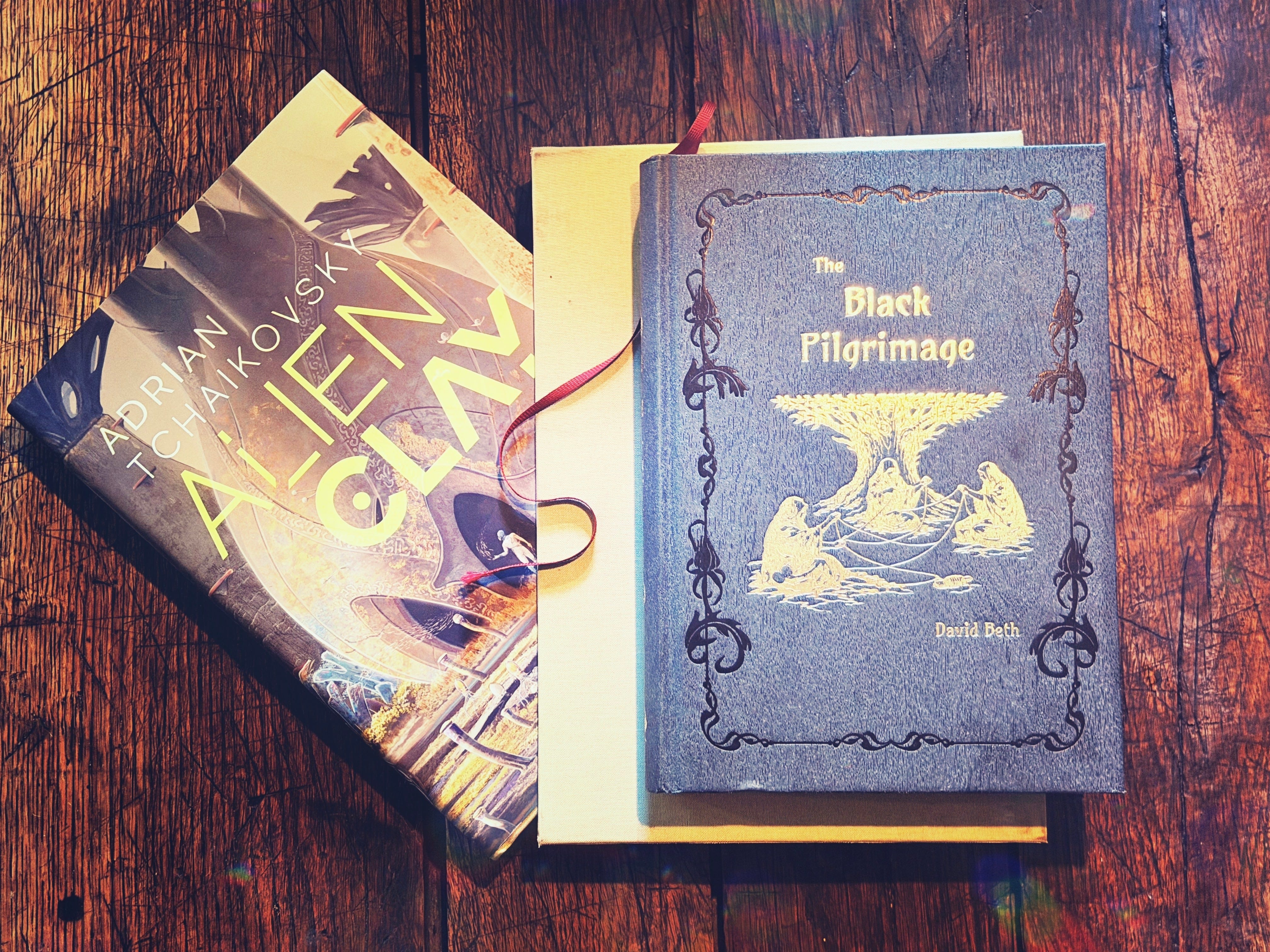
This week Paralibrum.com published my double book review of Adrian Tchaikovsky’s Alien Clay and David Beth’s The Black Pilgrimage.
Reading these books and writing their interlaced review was a genuine adventure I would not want to miss. It changed the markers on my horizon of mapping out and relating to an animistic world. I hope I can pass on a little of this experience to you here…
I.
Some novels teach more than technical manuals on the same subject ever could. Gustav Meyrink’s The Angel of the West Window belongs to this order: a tale that conveys more about Enochian magic than many non-fiction books devoted to the topic. So do the novels of Dion Fortune, Maria Szepes’ incomparable The Red Lion, and Mark Z. Danielewski’s House of Leaves, which renders the threshold between architecture, perception, and terror more vividly than any specialist study.
Such books do not explain their subjects. They make them habitable. Once opened, they become spaces into which our senses expand.
By placing in our hands artfully fashioned testimonies of averred experience, they invite us to become witnesses ourselves: not merely to read, but to participate; not to observe a matter from without, but to undergo it from within. Their knowledge does not lie in assertion, but in the simulation of lived reality. They teach by transporting us into a world where what is learned no longer appears as two-dimensional information, but rises into three dimensions: atmosphere, places, presences.
Novels of this kind are as rare as they are subjective. Yet when we find them — or, more precisely, when they lodge themselves between our eyes — we feel them break through the walls of instruction. They draw us towards that legendary, now cobwebbed chamber once known as initiation.
A handbook tells us what to do. A good novel seduces our senses into believing we have already done it. A good work of scholarship extends our knowledge. A good novel changes the very place from which we experience the world. It does not merely teach the object. It hollows out a space in our senses through which the absence of that object can first be felt.
Adrian Tchaikovsky’s Alien Clay belongs to this lineage. It teaches more about ecology, xenobiology, colonial blindness, and the violence of classification than many abstract treatises on these subjects ever could. It does not merely describe an alien biosphere. It forces the reader to inhabit the collapse of human taxonomy before an intelligence that is neither machine, nor animal, nor god, but something still more humiliating to our categories: life organized, and constantly re-organizing, otherwise.
The book begins brutally, without prologue, plunging us into a scene of existential violence: A one-way spacecraft disintegrates by design upon entry into the atmosphere of a strange planet: Imno 27G, nicknamed Kiln. Like seeds cast from a bursting husk, a cloud of cryo-sleep chambers is scattered across Kiln’s sky, while their unwilling passengers awaken, and many die, in free fall.
A cacophony of vibration coming through the curved surface to you: the death throes of the vessel which has carried you all this way, out into the void, and is now fragmenting. There’s a world below that you know nothing about, not in your head right then. And above you are only the killing fields of space. The fact there’s a below and an above shows that the planet’s already won that particular battle over your soul and you’re falling. The oldest fear of monkey humanity, the one which makes a baby’s rubbery hands clench without thought. Such a fall from grace as never mankind nor monkey imagined. (p. 4)
In 2020, Frater U∴D∴ published his gnostic meditations, with illustrations by Hagen von Tulien, under the telling title A Fall Like No Other. The opening sequence of Alien Clay deliberately summons memories of that most famous of all celestial falls. Yet here humanity does not descend from paradise into the bodily world, as in the gnostic myth. These people fall from a prison transport dispatched by a tyrannical regime on Earth, one that feeds the distant planet Kiln with a steady stream of new inmates. Their fall does not begin in paradise, but in the dark void of decades-long cryo-sleep. And it does not lead them into the familiar world of embodied existence as we know it. Rather, it throws them — and us, the readers — into another and utterly alien reality: that of Imno 27G.
[…]